


Sustainable Material Procurement
Currently, companies are expected by society as a whole to ensure sustainability in their supply chains.
As
a company that provides specialty chemicals globally, the NIKKOL GROUP has been actively working toward
sustainable material procurement.
We have a longstanding belief that this is an important aspect of
corporate
responsibility, since even before it became something that is expected of companies.
- Purchasing Policy
- NDPE Policy
- NIKKOL ECO-Friendly Policy
and Product Definitions - RSPO Certification
- Participation in ASD
- EFfCI GMP Certification
- EcoVadis
- Food Additive
Manufacturing License - Pharmaceutical
Manufacturing License
Unique Procurement Policy
Purchasing Policy
In cooperation with our business partners, the NIKKOL GROUP aims to procure sustainable and traceable raw
materials and supplies in its purchasing programs.
Therefore, in order to realize a sustainable business
structure, we have formulated and publicized our Purchasing Policy.
We ask our business partners to comply
with laws and regulations. We aim to establish an equitable supply chain for all our domestic and overseas
business partners. We aim for appropriate quality, price, and delivery conditions in a supply chain that
emphasizes management systems and corporate social responsibility.
- Compliance with laws and regulations
- Initiatives for compliance with regulations, certification, and action on environmental issues
- Highest quality standards
- Setting fair prices to enable competition in the global market
- Stable supply and appropriate packaging
- Requests in response to changes
- Technology
- Basic terms of purchase and sale (for contracts)
NDPE Policy

Nikko Chemicals formulated and published an NDPE Policy (No Deforestation, No Peat, No Exploitation) in December 2023. We are committed to procuring sustainable palm oil-related products by eliminating deforestation, respecting human rights, and supporting local communities. We strive to build and maintain supply chains based on this ethos. Based on this policy, we work closely with stakeholders to comply with regulations and laws related to the protection of forests, peatlands, human rights, and local communities. As a downstream user of palm derivatives, we aim to promote and implement the NDPE policy throughout our supply chain.
Sustainability Policy
NIKKOL ECO-Friendly Policy and Product Definitions
The NIKKOL GROUP considers sustainability a key management issue. In 2022, we established the “NIKKOL ECO-Friendly Policy” as our highest-level policy. This policy aims to reduce environmental impact and promote sustainable business activities from both social and economic perspectives. It is structured around the themes of “Ethical,” “Climate,” and “Origin.” Based on this policy, we define products that contribute to the environment and society as “ECO-Friendly products” and strive to promote their use. We have set minimum requirements, such as Roundtable on Sustainable Palm Oil (RSPO) certification and palm-free standards. Furthermore, we categorize our products under the themes of “Ethical,” “Climate,” and “Origin.” This approach allows us to offer our customers products with added value, including traceability, high biodegradability, and environmentally friendly manufacturing methods. Through this policy, the NIKKOL GROUP will contribute to the realization of a sustainable society, together with our suppliers and stakeholders.
For more information on the NIKKOL ECO-Friendly Policy and product definitions, click here.
- Ethical (ethical corporate activities): With an awareness of an ethical and sustainable society, we aim to achieve responsible raw material procurement and fair business practices that reflect the diversity of society.
- Climate (addressing climate change): We aim to contribute to preventing global warming and combating climate change by reducing CO2 emissions and waste, and by complying with environmental laws and regulations.
- Origin (utilization of sustainable resources): We will develop technologies and products using biotechnology and renewable materials to help create a circular society.
Global Certification
RSPO Certification
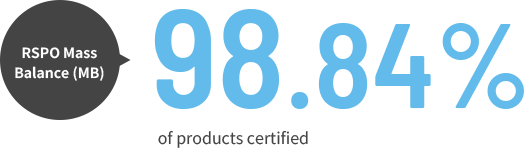
RSPO is an international non-profit organization focused on sustainable production and use of palm oil. The NIKKOL GROUP aims to maintain a sustainable supply system and conserve biodiversity. As part of this approach, Nippon Surfactant Industries and Nikko Chemicals (Singapore) have acquired RSPO Supply Chain Certification to manufacture RSPO Mass Balance (MB) products. As of 2024, 97.97% of palm derivatives purchased and manufactured by NIKKOL GROUP are RSPO MB certified.
> Our mill list is publicly available.
Participation in ASD
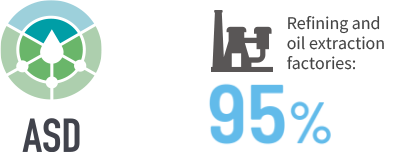
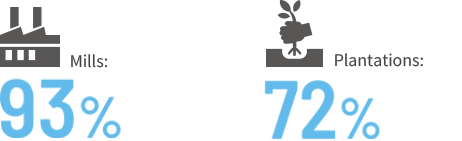
“ASD” (Action for Sustainable Derivatives) is an alliance of palm and soybean derivatives’ user companies in the personal care industry. By strictly managing the entire supply chain, including production areas (farms and plantations), processing facilities, oleochemical producers and final manufacturers of cosmetics, ASD is pursuing transparency and reducing environmental and social risks (such as deforestation, human rights violations, etc.). Nikko Chemicals is the first company in Japan to join ASD. As of February 2025, the traceability of palm oil derivatives handled by NIKKOL GROUP is 95% up to the refineries, 93% up to the mills, and 72% up to the plantations.
EFfCI GMP Certification
In February 2013, Nippon Surfactant Industries’ Utsunomiya Factory became the first in Japan to receive EFfCI GMP certification, the European standard for cosmetic ingredients. This certification reinforces hygiene control items not covered by ISO 9001 and enables quality control specifically for the production of cosmetic ingredients. In December of the same year, the company passed the maintenance audits for EFfCI GMP and ISO 9001:2008 (updated since to ISO 9001:2015). The Nasu Factory also received certification in February 2025. With this, all Nippon Surfactant Industries’ facilities are now EFfCI GMP certified.
EcoVadis
EcoVadis is a corporate sustainability assessment system provided by EcoVadis SAS, an independent assessment organization. It complies with major standards such as ISO26000 and evaluates companies’ CSR activities from the perspectives of “environment,” “labor and human rights,” “ethics,” and “sustainable material procurement.” Nippon Surfactant Industries was awarded the “Committed*” badge in October 2025. *This badge is awarded to companies based on the score requirements that represent “established” performance in the EcoVadis’ evaluation methodology.
Permits and Licenses within Japan
Food Additive Manufacturing License
Nippon Surfactant Industries’ Utsunomiya Factory is licensed to manufacture food additives for the Japanese market in accordance with administrative procedures.

Pharmaceutical Manufacturing License
Nippon Surfactant Industries’ Utsunomiya Factory is licensed to manufacture high-quality, safe, and reliable pharmaceutical products for the Japanese market in accordance with administrative procedures.

More CSR activities
Find out more about what we do in other CSR categories.